
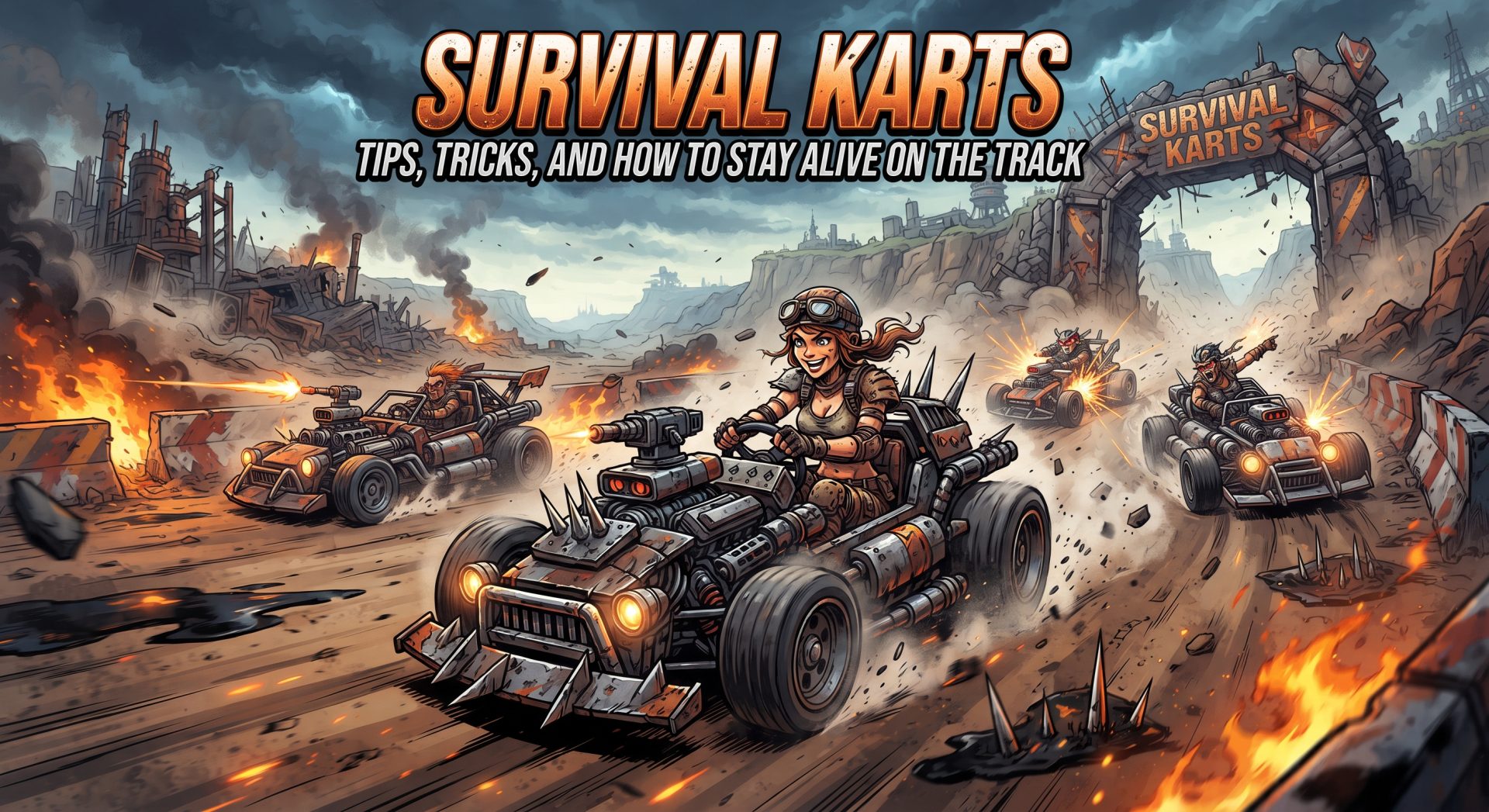
Kart racers are supposed to be cheerful, predictable, and family-friendly. survival karts is none of those things, and that is exactly why it is so much fun. It takes the classic idea of racing and adds hazards, crumbling tracks, and one very simple rule: the course wants to destroy you, and your only job is to refuse to be destroyed.
What is survival karts?
At first glance, this title looks like any other cartoon racing game. You sit in a tiny kart, the starting lights flash, and the engine revs. The difference appears the moment you hit the first obstacle. This is not a game about finishing first in a straight, clean sprint. It is a game about lasting as long as possible while the road falls apart, hazards appear from nowhere, and your precious kart slowly loses strength.
The core objective is to keep your kart healthy while navigating a track designed to punish you. Obstacles in the road, sudden ramps, spinning blades, and collapsing sections all take bites out of your health bar. The winner is not necessarily the fastest driver; it is the driver who survives the longest.
How the survival mechanics work
Understanding the health system is the key to improving quickly. Every hit you take drains your durability, and once it reaches zero, your run is over. The game throws a steady stream of danger at you, so careful driving beats frantic speed almost every time. Knowing when to slow down is every bit as important as knowing when to floor it.
Some sections of the track are static and require memorization. Others spawn hazards in patterns you must read in real time. The beauty of survival karts is that both kinds of danger interlock, forcing you to balance memory, reflexes, and risk management every single lap.
Reading boost zones
Boost pads generate tempting bursts of speed, but they come with consequences. Launching over a pad can carry you straight into a spinning hazard that you could have easily dodged at normal speed. Clever players use boosts sparingly, and only when the path ahead is genuinely clear. Wasting a boost into a crash is a beginner mistake, and avoiding it immediately puts you ahead of the pack.
Why randomness keeps it fresh
One of the most charming qualities of survival karts is that no two runs feel identical. The order in which hazards appear changes, and the way your kart reacts to collisions varies from run to run. That randomness keeps the tension high even after dozens of plays. You cannot simply memorize the entire game and coast to victory, because the game refuses to be predictable.
This design philosophy rewards adaptation. The players who do well in survival karts are not the ones with perfect route knowledge; they are the ones who stay calm when the track throws something new at them. It makes every session a small test of nerves, which is exactly why the genre has captured so many players.
Tips to survive longer
Improving your runs in survival karts comes down to a handful of habits. Build each of these into your driving and your average finish position will climb quickly:
- Scan ahead constantly: The biggest threat is a hazard you did not see coming. Keep your eyes two or three kart-lengths ahead of your nose, not glued to your own bumper.
- Slow down before trouble: Hitting an obstacle at speed does far more damage than meeting it at low speed. Brake early, miss gracefully, then accelerate past.
- Respect your health: A perfectly executed risky move is worthless if it ends your run. If you are low on durability, play conservative and survive.
- Study the static sections: Everything that does not move should become second nature. The more your hands know the track, the more attention you free for live hazards.
- Prioritize the finish line: Races in survival karts reward completion. A modest but steady speed that actually survives beats a lightning start that ends in a pile of rubble.
The competitive draw
Survival racing has a natural competitive hook because results are so easy to compare. Your best distance, your completed laps, and your longest streak all become numbers you want to beat. survival karts leans into this by giving you clear feedback on every run and plenty of reasons to push for one more attempt. That is a powerful loop, and it explains why players describe the game as dangerously easy to keep playing.
The joy of a near-miss
Ask any regular player about their favorite moment and it will rarely be a victory. It will be a near-miss: the grinding slide that stopped a kart-length short of a spinning blade, the perfectly timed hop over a gap everyone else missed, the lap completed on a single bar of health. This game is engineered to manufacture those heart-stopping moments, and they are why one quick race so easily becomes three or four.
There is also a welcome social element once you start comparing runs. Players trade stories about impossible escapes, argue about which section of the course is the cruelest, and bait each other into trying one more lap. In the browser-gaming world, where most titles feel disposable, this one builds genuine loyalty through shared adrenaline. Give it time, learn the patterns of each hazard, and you will start making your own near-miss moments instead of merely watching them happen to other people.
Choosing your line through the course
The best players do not simply drive fast; they drive smart, and route selection is where the biggest gaps appear. Look past the immediate turn and plan your kart's path two or three corners ahead. Wide entrances to sharp corners let you carry more speed through the exit, and hugging the inside line too early often sets you up for a wall in the next bend. Reading a course as a series of linked elements rather than a list of separate obstacles is a skill that transfers from lap to lap.
Pay attention to where hazards cluster, because courses love to force a choice between a risky shortcut and a safe but slower lane. Fresh players treat every shortcut as a trap, but veterans learn which ones are worth gambling on and which ones only look tempting. The health system changes these calculations too: with plenty of health you can afford the occasional crunch, but on low health the safe line becomes the smart line even if it costs a few seconds.
There is also a rhythm to good racing. Smooth steering, gentle braking, and well-placed boosts produce better lap times than constant full-throttle driving. Once you stop fighting the kart and start working with it, the course starts feeling like a dance instead of a battle, and your finishing positions improve without you even having to push harder.
Frequently asked questions
Is survival karts free to play?
Yes. You can launch the game directly from your browser without paying, and the full racing experience is available immediately.
What devices does it support?
It is designed for lightweight play and runs comfortably on laptops, tablets, and desktop computers, which makes it a favorite for quick breaks.
Is winning about speed or survival?
In survival karts, survival always comes first. The winner is the driver who stays on the road longest, not the one who briefly leads the pack before crashing out.
The final lap
There is something deeply satisfying about a racing game that refuses to be easy, and survival karts delivers on that promise with every lap. It wraps a familiar cartoon style around a genuinely tense survival loop, dares you to take unnecessary risks, and rewards the brave, careful driver above all. If you are tired of polite racing games, it is time to hit the start line and see how long you can survive.