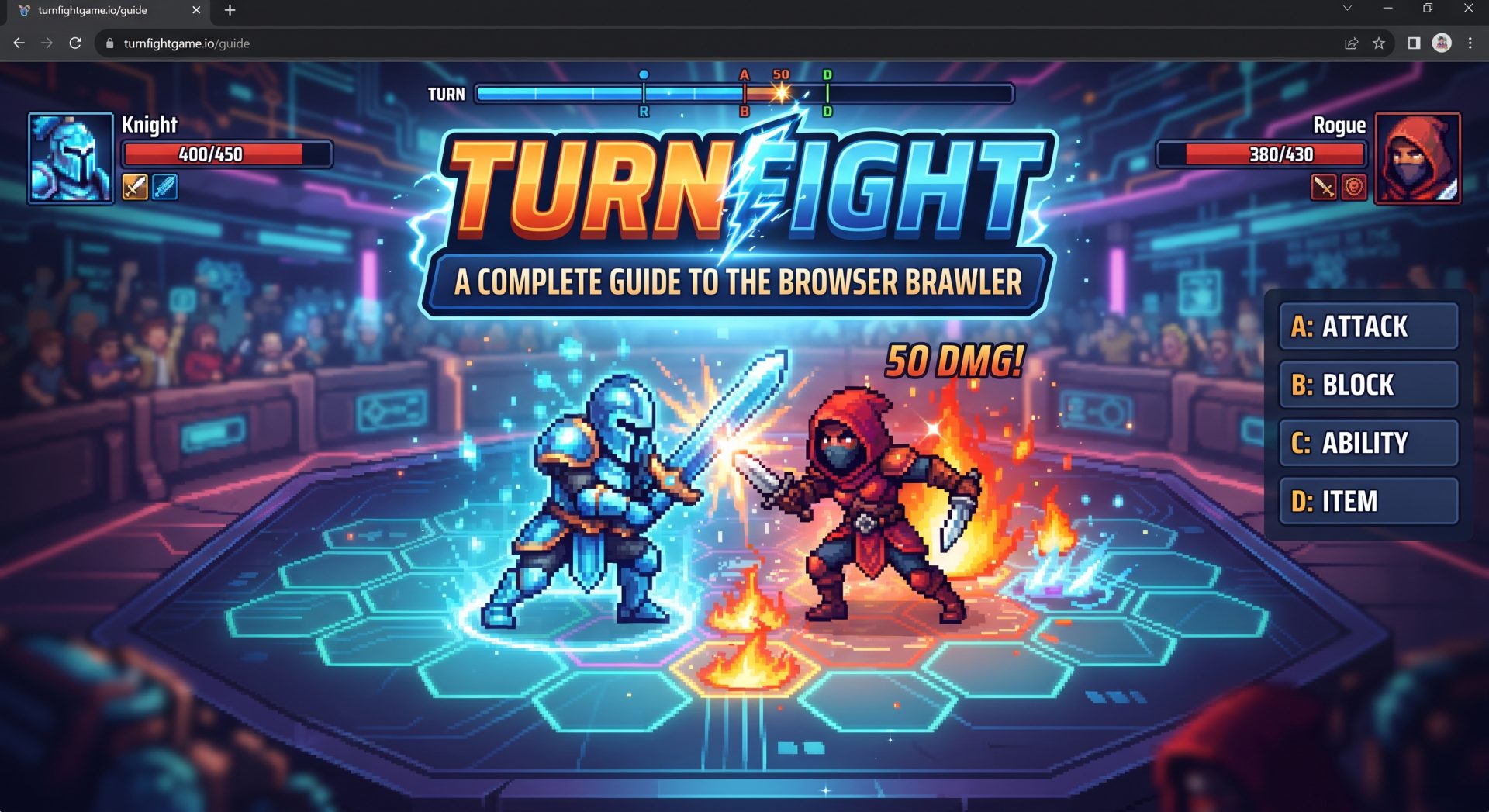
Most browser fighters demand lightning reflexes, but this one rewards patience instead. turnfight is a turn-based brawler fighting match where you steer a fighter through rounds of movement, dodging, blocking, and special moves. There is no timer pressure and no button mashing; every action is a deliberate move on a shared grid, and the winner is usually the player who thinks two steps ahead. It runs directly in the browser, loads in seconds, and manages to feel remarkably deep for such a simple package.
How turnfight Turns Brawling Into Chess
The traditional fighting game is built on reactions. Players drill combos, memorize frame data, and lean on muscle memory that takes hundreds of hours to develop. The premise of turnfight inverts that entire philosophy. Instead of both players acting in real time, each side issues commands on a turn-by-turn basis. You move, and then your opponent moves; you attack, and then your opponent answers. Because everyone gets a chance to respond to the situation, the match turns into a layered guessing game rather than an input contest.
This design creates a fascinating rhythm. Early in a round, movement dominates as both fighters search for an advantage. Then the tempo shifts, and the pace accelerates as meter builds and special moves become available. The best moments arrive midway through a match, when both players have watched enough of each other's habits to start baiting traps. Watching a skilled bout is like observing two boxers circling, feinting, and answering at a deliberate pace.
The turn structure also flattens the learning curve. A player who has never touched a fighting game can read the options on screen and make a reasonable choice from the very first round. The interface is clean: each fighter occupies a tile on a small arena, and the available actions appear as buttons directly below the field. There is no steep wall for inputs, only a gentle slope for strategy. That accessibility explains why the game has built a loyal community inside classrooms, offices, and anywhere a quick match is welcome.
The Core Loop Inside Every Round
Every round in turnfight follows the same rhythm. You begin by positioning your fighter on the grid, then commit to an offensive or defensive action. Once both sides confirm their commands, the game resolves them in order and displays the outcome with a brisk animation. Understanding that resolution order is the key to climbing the ranks in turnfight, because it determines which actions beat which.
Movement and Positioning
Movement is the most underrated part of the game. Each fighter can slide sideways, advance forward, or retreat backward within the limits of the arena. Skilled players use movement to control spacing, keeping the opponent at the precise range where their fastest attack connects and the rival's version whiffs. In a turn-based system, positioning matters doubly, because your opponent watches your placement before choosing their own answer. If you shuffle left, you signal an interest in their weak side; if you back away, you invite aggression. Every step broadcasts information, so seasoned fighters vary their patterns constantly.
The Dodge and the Read
The dodge is your escape hatch. It is quick, and it lets you slip past an incoming strike while opening the attacker's guard. The catch is that dodges become predictable if you lean on them too heavily. Once an opponent notices you dodging on the second turn of every round, they will start throwing delayed attacks and throws designed to punish the habit. Strong players treat the dodge as a rare and precious resource rather than a default response to any threat.
Reading your opponent is the real combat. Each player develops tells over the course of a set: the way they open a round, the direction they prefer to circle, the moment they start relying on meter. The players who win consistently are the ones who harvest those tells and translate them into counterplay.
Blocks, Grabs, and the Guard Game
Blocking does not look flashy, but it wins fights. A successful block cancels most incoming damage and opens a short window during which the attacker is vulnerable to a punish. In turnfight the block is stronger than a reflexive dodge in one important way: it reliably shuts down both high and low strikes when timed correctly. A disciplined blocker can grind out rounds while taking almost no meaningful damage.
There is a cost, of course. Holding the guard for too long broadcasts caution, and observant rivals will answer with a throw. Grabs bypass shields entirely and cannot be blocked. The permanent puzzle at the center of every match is balancing the block, the dodge, and the occasional gamble on a counterattack, because perfect defense is just as dangerous as predictable offense.
Special Moves and Meter Management
Special moves are the showstoppers of the game, and in turnfight a well-timed special can flip a whole round in a single animation. Each character carries a signature ability that consumes meter, and meter fills as you land attacks, absorb blocks, and take hits. Some specials are devastating finishers, some are defensive reversals, and a few reshape the arena itself.
Know Your Character's Toolbox
The roster may be small, but the fighters are meaningfully different from one another. A heavy bruiser wants to close the distance and end rounds in a handful of exchanges. A nimble trickster thrives on dodges, chip damage, and hard to punish pokes. Spend your first few matches of any session studying what your chosen character can do at every meter level, because the best specials are useless when misused.
When to Spend Your Meter
Wasting meter is the classic beginner mistake. Launching a flashy super in the opening seconds feels great, but the damage is rarely worth more than saving that meter for a guaranteed punish later in the round. The smart play is to hold the bar until you see a clean opening, a mistimed dodge, or a rival trapped in a corner, and then spend everything at once.
Ten Habits That Instantly Improve Your Win Rate
Competitive play rewards habits more than raw talent. These small adjustments, practiced for a few sessions, will raise your results quickly.
- Count squares before you act. Knowing exactly how far your attacks reach prevents wasted turns and sloppy whiffs.
- Never repeat the same two-move pattern two rounds in a row. Rotate attack, block, and dodge to keep your opponent guessing.
- Spend meter only on guaranteed punishes and save the meter for the final exchange of a close round.
- Watch the first movement of each round. Most players telegraph their opening strategy with their initial shuffle.
- Use the corner as a weapon. Trapping a rival against the arena edge removes their retreat options and sets up your best combos.
- Punish predictable block spam with throws, and punish predictable dodge spam with delayed attacks.
- Track your opponent's tells across the whole set, not just the current round.
- Favor clean positioning over fancy specials in the early rounds; keep your health bar healthy.
- When you take the lead, stop gambling and force the opponent to come to you.
- Take a breath between rounds. Turn-based play rewards calm decision making above all else.
Why the Browser Is the Perfect Home for This Game
The greatest strength of turnfight is convenience. There is nothing to install, no account is required for casual play, and a full set of matches fits neatly inside a lunch break. Because the gameplay is turn-based, lag and network hiccups matter far less than they do in a real-time title. That makes the experience smooth even on weak connections and turns the game into a dependable fallback whenever a few spare minutes appear.
Session design respects your time as well. Rounds are short, rematches sit one click away, and the ranking system hands you a clear goal without demanding hours of grinding. For a browser title, the pacing is unusually respectful of the player's schedule, and that is exactly why so many people keep coming back for one more set.
Frequently asked questions
Is turnfight free to play?
Yes. The core game, including ranked matches and the full starting roster, costs nothing and runs in the browser. There are optional cosmetic items, but nothing you buy affects the balance of a match.
Can I play turnfight offline?
The single-player training mode works offline once the page has loaded. Online matchmaking needs a connection, but the local practice arena is always available for polishing your timing and testing combos.
How long does a typical match last?
Most matches finish within a few minutes. A best-of-three set usually runs between five and eight minutes depending on how defensive both players decide to be.
What characters are best for new players?
Sturdy all-rounders are ideal for beginners because they forgive positioning mistakes. Once you understand spacing and the guard system, branching out toward the faster, trickier fighters becomes far more rewarding.
Does turnfight run well on school computers?
Yes. The game targets low-end hardware and keeps its visuals simple in the browser. Practically any machine from the last decade can run it without a problem.