Website Redesign Services for Small Business: When and How to Redo Your Site (2026)
A website redesign is equal parts opportunity and risk. Done right, it lifts conversions, modernises your brand and gives you a platform to grow. Done carelessly, it can quietly destroy the organic traffic you spent years building. The difference between those outcomes is process. This guide covers when a US small business should redesign, what it costs in 2026, and how to execute a redesign without tanking your SEO.
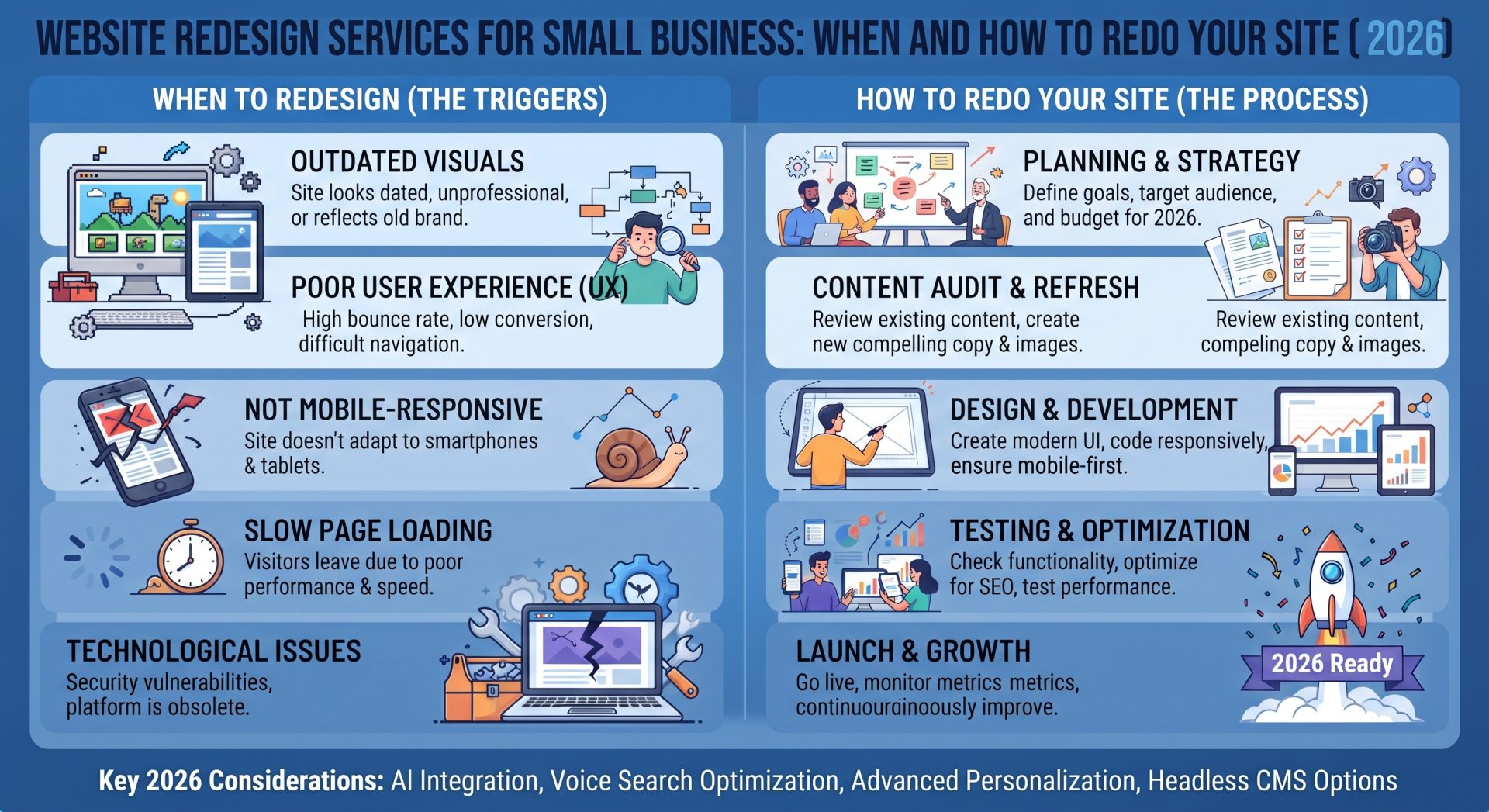
Five Signs It Is Time to Redesign
- Your bounce rate is climbing. Visitors arrive and leave fast — usually because the site looks dated or fails on mobile.
- Your site fails mobile tests. If customers must pinch, zoom or scroll forever, you are losing them daily.
- It takes five seconds to load. Speed is ranked and felt. Slow is expensive.
- The design predates your brand. If your website looks ten years older than your actual business, it is costing you credibility.
- You cannot make simple edits. When every small change needs a developer, the site has become a liability.
What a Small-Business Redesign Costs (2026, USD)
| Redesign type | Typical cost | Timeline |
|---|---|---|
| Visual refresh (same structure, new look) | $2,000 – $6,000 | 2–5 weeks |
| Full redesign with new structure | $5,000 – $15,000 | 6–12 weeks |
| Redesign + rebuild on a new platform | $8,000 – $25,000 | 8–16 weeks |
Redesigns run higher than first-time builds for a reason: there is existing content to audit, migrate and improve — and existing rankings to protect. An experienced partner treats that as the core of the job, not an afterthought.
The Redesign Process That Protects Your Rankings
1. Audit Before You Touch Anything
Pull your analytics and Search Console data first: which pages earn traffic, which keywords convert, which URLs people book mark. This becomes your migration map.
2. Map Every Old URL to a New One
Every page that currently ranks needs a destination. A properly executed 301 redirect plan preserves link equity and prevents the classic post-redesign traffic cliff. This is where working with our SEO and performance expertise pays for itself in retained traffic.
3. Improve Content, Don't Just Restyle It
Bring your ten best pages forward and make them better: tighter copy, stronger headings, clearer calls to action. Archive the rest. A redesign is a content opportunity.
4. Build Fast and Mobile-First
Design for mobile-first indexing, compress every image, and test from launch on real devices. Speed targets should be part of the acceptance criteria.
5. Launch, Monitor, Adjust
After launch, watch rankings and conversion analytics weekly for the first month. Fast responses to anomalies protect the investment you made.
Avoid These Redesign Traps
- Letting designers redesign the experience instead of your sales process — the site should be built around how customers buy.
- Changing URLs without redirects — the fastest way to lose rankings overnight.
- Scope creep. New features mid-project inflate budgets and delay launch. Freeze the scope.
- Forgetting content ownership. Keep terms, policies and legal pages in the new build.
How to Brief a Redesign So Everyone Stays Honest
A redesign lives or dies on the quality of the brief. Start by writing down what success looks like in numbers — more enquiries, faster load time, better mobile bookings — rather than vague goals like "modern." Next, inventory your current content honestly: which pages exist, what converts, what is dead weight. A good agency will tell you to cut, merge or archive a third of your pages rather than rebuild them all, and that honesty saves you real money. Then bring references: two or three sites you admire, with one-line notes on which element and why, so the designer is interpreting examples, not guessing metaphors.
Agree beforehand on what "done" means. Does it include content migration, redirects from all old URLs, analytics reconfiguration and team training, or only new visuals? Redirects are the detail that quietly hurts redesigns — without a proper redirect map, you lose ranking and inbound links on launch day, and fixing it later is painful. Finally, define a change-control process: after design approval, small text edits are free, but structural changes trigger a clear supplementary cost. This is not the agency being difficult; it is the only way both sides stay honest about scope. With a tight brief and stated rules of engagement, a redesign becomes a predictable investment rather than a negotiation that starts fresh on every call.
Budget is not the only reason small businesses hold on to an old site. A refresh that updates the look, sharpens the messaging and removes dead pages may be the smarter financial decision even when a full rebuild is affordable, because it preserves your hard-earned ranking, inbound links and the content that already converts. The evidence usually shows up in the analytics: high-traffic pages that still perform can stay untouched. The decision should be made from data and goals, never from fatigue with the current design — tiredness is exactly when owners redesign, and exactly when they spend money that a targeted refresh plus a stronger homepage would have delivered for a fraction of the return.
Do You Need a Full Redesign or a Refresh?
If your structure and content still convert but the site looks dated, a refresh — new design system, updated imagery, faster performance — is usually enough. If the structure, content and platform are all holding you back, a full redesign is the right call. Knowing which you need saves five figures.
Frequently Asked Questions
How long do I keep my old site?
Keep it live in parallel until the new site passes testing and analytics checks. Never switch off the old site the day the new one dots the 'i'.
Will I lose my SEO during a redesign?
Not if the redirect map and structure are planned properly. Most ranking losses come from poor migration, not the redesign itself.
How often should a small business redesign?
Every three to five years, or whenever the site stops performing — whichever comes first.
Final Thoughts
A redesign is a chance to rebuild trust, speed and conversion around today's customer. Protect what you have, improve what works, and use a process that treats traffic as an asset. If you are weighing a redesign, send us your current URL — we will give you an honest view of whether a refresh or a full rebuild makes sense for your business.