WordPress Website Design in Singapore (2026): Costs, Multilingual Standards and Post-Launch Traps
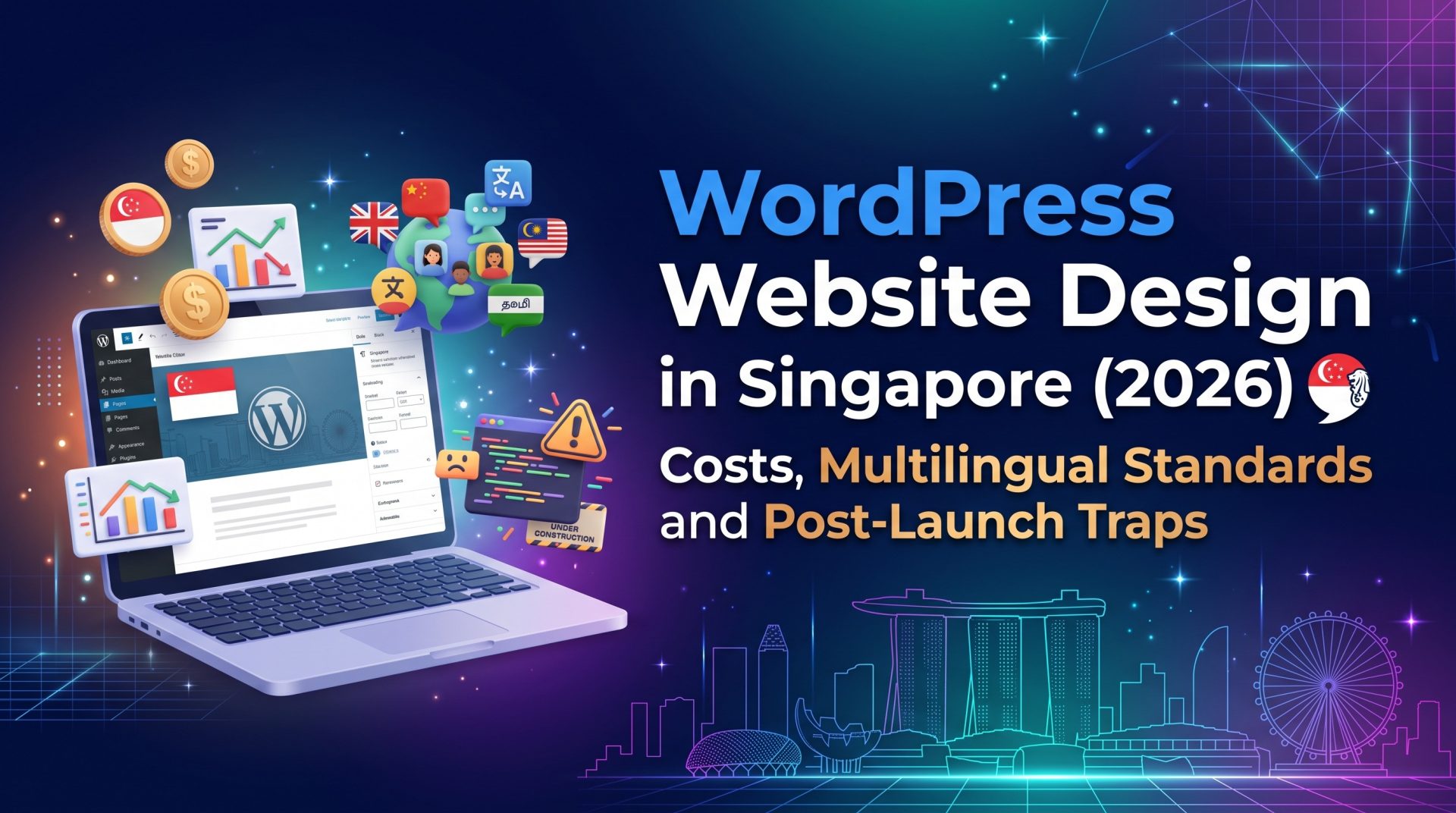
Singapore businesses choose WordPress for a simple reason: ownership and flexibility at a sane price. But a "WordPress website" in Singapore can cost SGD 1,200 or SGD 18,000, depending on everything the words do not say — hosting location, multilingual setup, plugin architecture and who maintains it afterwards. Singapore's audience is unusual: demanding about speed, mobile-first by habit, and multilingual in practice across English, Chinese and Malay. This guide maps what WordPress design really costs in SGD in 2026, what Singapore standards demand, and the maintenance trap that quietly follows most launches.
What WordPress Design Costs in Singapore (2026, SGD)
| Scope | Typical cost (SGD) | Notes |
|---|---|---|
| Template WordPress site | SGD 800 – $2,500 | Standard template, setup, basic content |
| Business site with custom design | SGD 3,000 – $8,000 | Bespoke look, content, integrations |
| Multilingual WordPress build | SGD 5,000 – $12,000 | EN/中文/Malay, translation workflow |
| WordPress + ecommerce or portal | SGD 8,000 – $25,000+ | Stores, bookings, memberships |
Most Singapore SMEs find their home in the design band of SGD 3,000–8,000 — custom enough to feel deliberate, affordable enough to justify as a business cost.
Why Singapore Standards Are Different
Mobile is the default
Singapore consumers live on phones, and they abandon slow pages the way they exit a crowded MRT at peak hour. Mobile-first is not an option; it is the floor. The winning Singapore WordPress site is speed-tested on a real connection, with images compressed and plugins kept lean before launch day.
Multilingual is expected, not exotic
A large share of Singapore businesses serve audiences across English, Simplified Chinese and Malay — and sometimes Tamil. A proper multilingual build is not a translate button; it is a structured setup where each language has clean URLs, correct typography and a workflow your team can maintain. Done well, it is a major competitive edge; done poorly, it is a visible inconsistency that erodes trust.
Business credibility is instant
Singapore customers Google, check reviews and compare within minutes. A polished, current site with real contact details and clear service scope is table stakes. The design standard in this market rewards quiet precision over loud decoration.
Hosting, Domain and Email Nuances
Hosting location matters for speed and, sometimes, for compliance. For a Singapore audience, a reputable host with a Singapore-region server (or a good CDN) keeps load times local. Domains might meaningfully be a .com.sg or .com, and professional email at your own domain is expected — Gmail on a business card reads as amateur in this market. All of these are operating costs that belong in the twelve-month budget you discuss with your designer, not surprises in month four.
Themes, Plugins and the Maintenance Trap
WordPress gives you freedom; that freedom is also the trap. Sites that launch with dozens of plugins, a heavy visual builder and no update discipline age badly: they grow slow, break at the worst time and need emergency repair at emergency prices. The Singapore businesses that avoid the trap plan for it — fewer, better plugins; a theme that does not lock you in; a maintenance cadence agreed before launch. Ask your designer what happens monthly, whose calendar owns the updates, and where backups live. The answer will tell you whether you are buying a website or a recurring problem.
Getting the Design Right the First Time
Redesigns are expensive; the first build is the cheap one if it is done properly. That means agreeing the content before the design, approving pages on real text instead of lorem ipsum, and testing the booking or contact flow on a real phone with your real forms. Singapore owners who treat the build as a process — discovery, sitemap, design, build, test, launch, tune — consistently get more value than those who ask for twenty templates and expect the designer to read minds. Communicate in specifics: which pages, which languages, which conversion, which deadline.
Budgeting Beyond Launch
Set aside for the reality of running a website: annual hosting, domain renewals, an SSL certificate, content updates and the occasional improvement. Singapore businesses that ignore the "what happens next" numbers the most are the ones who blamed WordPress later — usually wrongfully. A small monthly care allowance converts the site from a project into an operating asset, and the difference in results is visible within a year.
Frequently Asked Questions
Is WordPress still the right choice in 2026?
For most Singapore SMEs, yes — ownership, cost and an enormous ecosystem of themes and plugins still favour it over proprietary platforms once you control the hosting and maintenance.
How much extra does a Chinese version cost?
Plan for roughly 30–50% over the base build for a proper second language, depending on translation and how integrated the workflow must be.
Who should maintain a WordPress site in Singapore?
Either an internal owner with basic training or a care-plan provider. What never works is nobody — that is precisely how sites start dying in month six.
It is also worth planning your content in the same language your competitors publish in. A Singapore site that updates in English only will quietly fall behind one that serves its full audience, and the cost of multilingual maintenance is a running cost, not a launch event — budget for translation and review on a schedule, not as an afterthought. Keep a small editorial rhythm true to your business: a refreshed service page, a genuine case study, an FAQ updated with the questions real customers ask. Search engines reward freshness and completeness, and the Singapore customer rewards factual usefulness over marketing flourish.
Finally, ask the designer how they will hand it over: training, documentation and a fix-it window say the relationship is professional; a login and a goodbye do not. Ownership and a maintenance plan are the two lines in any contract that predict whether the site ages well. Choose the partner who expects to be there in year two, and you will rarely need to be rescued in year three.
WordPress in Singapore pays off when it stays lean, fast and maintained. Decide who owns the care before the launch, and the platform will quietly earn its keep for years.